FLUX.2-klein Text Encoder Pruned to 5.1B
A structurally pruned, distillation recovered drop in replacement for the 8.2B Qwen3 text encoder of FLUX.2-klein-9B. 38% fewer parameters, under the 12 to 16 GB VRAM thresholds, with matched image quality.
A structurally pruned drop in replacement for the 8.2B Qwen3 text encoder of FLUX.2-klein-9B: 8.19B → 5.10B parameters (38% smaller), recovered by hidden state distillation against the original encoder. The DiT and VAE are untouched. This is a text encoder only, and it’s what brings the fp8 pipeline under the 24 / 20 / 16 GB VRAM thresholds (the original bf16 encoder needs ~26 GiB fully resident).
| Original | Pruned | Pruned (fp8) | |
|---|---|---|---|
| Parameters (encode path) | 7.57B | 5.10B | 5.10B |
| Weights | 14.1 GiB | 9.5 GiB | ~4.8 GiB |
| Encode phase peak VRAM | 15.5 GiB | 10.6 GiB | 6.8 GiB |
| Embedding fidelity (masked token cos) | 1.0 | 0.9755 | 0.9750 |
How it works
FLUX.2-klein’s pipeline consumes only three intermediate hidden states of its text encoder (layers 9, 18 and 27 of 36). The encoder is a feature extractor, not a language model. That makes large parts of it removable:
- Tail drop: layers 28 to 35 are never read. Removed exactly, no quality cost.
- Layer merge: layers 10 and 19 SLERP merged into their neighbours.
- FFN pruning: activation aware (Wanda) pruning of MLP width 12288 → 8192.
- GQA head pruning: whole key value groups removed per layer, guided by a per layer sensitivity probe rather than a uniform budget.
- Export time removals: the
lm_headand the final unused decoder layer.
After each stage the model is recovery distilled against the original encoder with per tap hidden state losses and a DiT proxy loss through the frozen transformer.
On quality
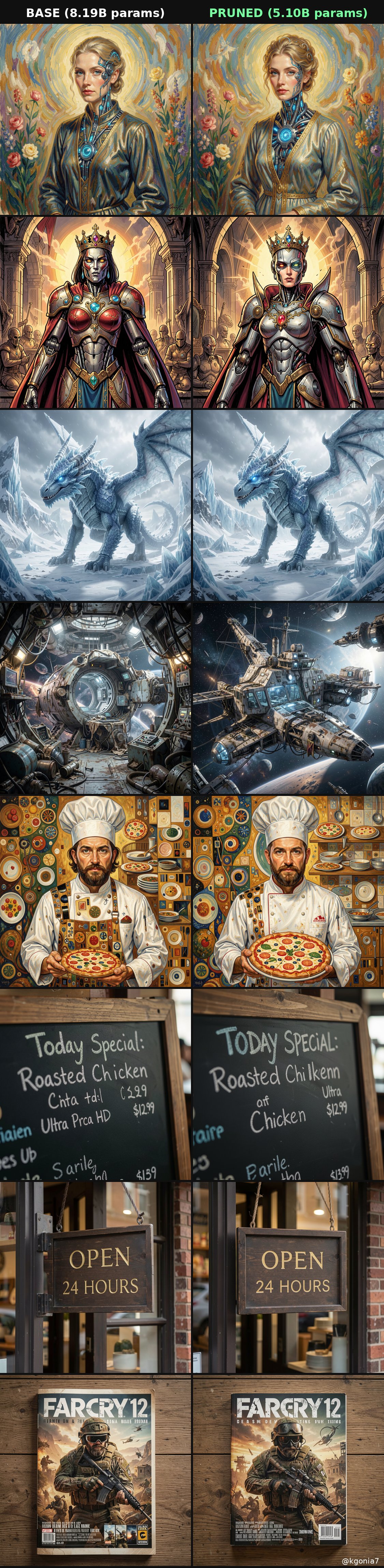
The pruned encoder gives you a different render of the prompt, not a worse one.
To verify this I generated the same 25 prompts with both encoders and compared the results with SSIM. The pruned encoder scores 0.59 against the original. For scale: run the original encoder on two different GPUs and its own images only agree at 0.36, because tiny numeric differences are enough to change a render. By that yardstick, the pruned encoder stays closer to the original than the original stays to itself across hardware.
Base on the left, pruned on the right. The last three rows test text rendering: